Pages

Thursday, July 21, 2011

Maria Magdalena

As I was reading the following chapters of the book " The Karma of Untruthfulness", some of the old customs and traditions of conceiving have come again to mind.

The usual way of conceiving a child was during the full moon after spring equinox, thus resulting in babies born around Christmas or Winter Solstice. This was in accordance to the atavistic consciousness of these old inhabitants, and yet I have to say that it is also something that is happening nowadays, though maybe not just out of atavistic conditions. Observing the cycles and soul stirrings, one can behold the fact that (at least for the last 8 years) women around us or even ourselves have experienced a stronger force around that time leading up to Easter, to call upon our will the conception of children. Yet it is mistakenly a fact too, that many times the conception does not occur if our will is not completely surrendered to the force, as to remind us constantly of the saying: "Thy will be done, not mine"

I recognize in my etheric body a part that has almost a form of a Moebius string, and when the upper part of the Moebius is working, the external works of the etheric are functioning, the memory, the capacity to organize the external world, housekeeping, and building up externally. Yet when the down part is at work, is the inner works of the etheric, maintaining a child in the womb. Thus it is explained while gravid women have less memory, less capacity of organizing, even mental thoughts, they need more sleep in order to refresh, etc.. and also the fact that just previous delivery, suddenly the etheric is released from the inner works and can put the outside world in order (cleaning the house predelivery syndrome). A note must be said that until three years old, children are also linked with the etheric of the mother, thus creating a surplus of work for the Moebius string which is now linked to the children as an umbilical cord.

All these facts come to mind and serve as further exploration of the spiritual world, just as how to consciously use our etheric forces, for one purpose or another during the course of the year and yielded or not to Divine laws.

Maria Magdalena's festivity is on July 22nd, and I am reminded too of the place the Mother as homemaker has, like a priestess, and especially also as a homeschooler. There is a passage of the book the "Peddlar's Progress" that again stresses the importance of that fact of being a teacher:

"Alcott is not unduly modest in the claims he makes for his newfound profession. the teacher, he repeatedly asserts, is a far more important man in the community than the preacher can never hope to be, for the reason that he works as it were from ground up, and while there is yet time. He is practical, shaping the molds of conduct, whereas the preacher is ordinarily a bookish theorist. The task of the teacher is holier than that of the minister because it deals with souls new-come, unstained, and still "trailing clouds of glory"....Upon the whole, then, a teacher's task is the greatest task to which any man can devote his life"

Thursday, July 14, 2011

Why Homeschooling

This is a question many times forgotten, and we all have probably different reasons or motives for homeschooling our children.


I just have been reading a book that exemplifies in the firsts chapters one of my main answers to the question in the title. I will just quote from the book itself: "Peddlar's Progress"  by Odell Shepard.


"...Then and there they may have decided what they afterwards firmly knew and taught, that a formal schooling, even when good, is not the only means of securing an education. Against the American worship of the school, so stupid in itself and so stultifying in its effects upon real intellectual life, one would be glad to think that they set their young faces, even then, like flint. To Bronson in particular there may have come some vague premonition of his future knowledge that the school, at its best, is only a substitute for the family and the home, that it is a miscrocosmos of society, a place in which one learns by doing, and as Thomas Carlyle was to say: "a collection of books".

.....The family, the home, one's mother-there was the best school of all...Was not his mother a far wiser, kinder, gentler, and in every way better person than the schoolmistress? And what could that mean, unless there are more important things in the world than reading, writing, and exact knowledge of the length of the Zambezi river? His mother knew things too, although one never found them set down in books, and even she seldom tried to say them in words. She said them in the way she acted, in the touch of her hand, in the smile of her eyes; and often she seemed to be saying them when sitting quietly beside him, paring apples or mending a hole in his homespun coat"

All these special figures that surround the life of children when they grow up are of utmost importance. The Mother role is central in the first three years of life, and then slowly it passes the torch to the world by the hand of the Father figure. You could observe that many times discipline problems or quarreling among siblings stems from the lack of loving co-operation between spouses: The more the wife submits her own selfish wishes to the wealth of the family, which is guided by the father's natural authority, the better the children learn. In like manner, the more the husband loves his family by turning down his own selfish desires and yielding to the overall wealth and family's needs, the better the children respond.


It is strange though that in this post about why homeschooling I am announcing an experiment that will start this year: to homeschool out of the home:


Now that my younger child is 4 years and a half, we decided to rent a room near our home, and to make it a place for the main schooling hours of the morning.


The room is shared with two other initiatives, one concerning the care of the dead when passing the threshold, and the other is an anthroposophical group. There was a name hinted up for all three of the groups, Threefold Center, but I rather called it The Upper Room. Besides being a room on the 2nd floor of the building, hence the upper adjective, it simbolizes for me the tasks at hand for this epoch: the two streams that have to come together, and the finding of Christ in the etheric.

Besides the homeschooling hours Monday through Thursday, there is:
- a program for familes and children on Fridays,
-probably some after school care hours for the children that go to school,
-Wednesdays study group
-and a puppetry group.

Thursday, July 7, 2011

Summer Conferences in Viroqua

There are two things already scheduled this summer in Viroqua, the town we live in. If people from abroad would be interested in coming, we would be able to accomodate them in homes. Let me know or contact any of the organizers so we could also plan things around in that case ( eurythmy, nurturing art classes...).

July 13th Wednesday 19:00pm : Homeschooling talk with Donna Simmons at the Old Main Building.

We do not know Donna's plans for the coming year, but there are chances that she would be going abroad. This is again a special opportunity to meet her and learn from her in person!! Organizer: Rice Spann arroz@frontiernet.net

My Photo


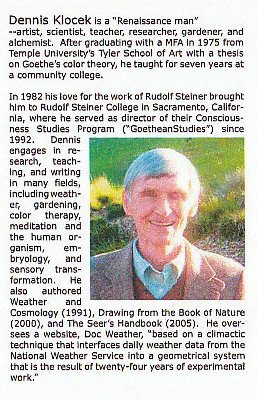
July 29th&30th Friday night and Saturday all day: Sacred Agriculture conference with Dennis Klocek at the Old Main Building.

Thursday, June 30, 2011

War and Politics

There is a story in my early youth that made a deep impression in me. I was in first grade and that day our teacher was absent, so we had a substitute. She had to go out of the room for some minutes and left us, some 25 children, alone with some work to do. At that point I remember getting up from my seat, many of us were out of the seat anyway, and started telling every girl about how unjust were the boys treating us, and that we ought to take some action, some revenge. Thus in a couple of minutes a war ensued, and we had half the class throwing tinfoil made balls and pieces of chalk to the other half of the class. There was indeed just on girl that was not convinced by my arguments, and did not participate, but all the rest joined in the uproar.


Th substituter teacher came in in the midts of it, and took as responsible ones the usual boys that always got into mischief ...I did not come forward to assume my fault or to speak about the truth.


This incident haunted me for all my life, not just for my feeling of cowardice, but also for the working of politics. I knew politics at that time, at least these kind of politics. It was clear to me that my motives for bringing this war were very selfish, I had accumulated a resentment towards my three years younger brother, and that spilled over to all the boys of the class.


It is no different many times, in our lifes, when the motives for even some acts that we may consider just and wholesome are based on lower human nature. I am just starting to read The Karma of Untruthfulness, by Steiner, where he discusses the underlying truths about the  First World War, and it does relate very much to a question of power.


Many times, the quest for power is reigning around us, hidden under our best motives. I have seen the movement of terrorist groups in my country, where they have started with high ideals and a well-intentioned agenda of taking care of the defenseless against the big powers, and yet, little by little, the leadership of these groups turn to the same quest of power they are trying to obliterate, and violent leaders take the reins, thus transforming good into evil.


Just last Tuesday we were discussing the calling of the Spirit to take action. Sometimes we are lead by the Spirit, and we have resistance to it, just like Moses did not want to take part of the plan God had laid for him, or Jonah had fled away from the commands of the Lord. But these times are in my eyes a good sign, because if we do not want so readily to obey there are good chances that there is nothing for us to gain in it, in terms of our low human nature, no praises, no self-satisfaction, no power gained, and thus our heart would be more pure in this action that we resist to do than in others that we may feel called and are very willingly entering to. Meanwhile we can work in purifying our hearts, so our own intentions gain clarity with truth and can be cleaned of selfishness.

Thursday, June 23, 2011

Ironing and the Will

My great aunt Carme was like a mother to me, we grew up with her, she was our caregiver during the week and so we loved her very much. She used to work when she was very young at the ironing house, near the Plaza del Pi, and she told us stories about how hot it was in the summer, to iron, and how many shirts, towels, linen, would be awaiting in the pile each day.


Our closets were very well organized, every dress, sock and underwear neatly ironed and properly folded away, and I remember admiring the beauty of that sight.


Now that I carry my own household, I long for those closets. My house is more or less well organized, but ah! if you look inside the closets you would see the mess there is...and I think this is because of the will.


Now, do not get me wrong, I do not think that extreme neatness is beneficial, on the contrary, there is a balance to the health in the soul, mind and spirit, but in my case I see perfectly well that an exercise of ironing would strenghten my will. It is the penetration of the will in matter that is to be accomplished and through ironing even the most menial clothing, I am hoping to exert my will through material resistance.


Here are some quotes about the will in the book that I mentioned last week that illustrate this weakness of will prevalent in our times:


"We do not know how to use the will, or rather we will into a vague and fugitive manner..............Now this is our great fault with resolutions: they are not specific enough.......your resolutions must take to be practical, and on this condition only will they be efficacious"


"Will with perseverance! Never abandon your resolutions because you were unsuccesful.......A person who is truly humble, instead of feeding on grief, rises at once and relying more on the mercy and goodness of God than on her own strength, takes up the march again. To learn to profit by our falls is one of the secrets of perfection, and an essential requisite of spiritual progress."


Now there are also different intensities of the longing: starting with a desire, then a wish, then a mission or goal, an aspiration, and when finally its gets to be a resolution, our strenght is totally engaged in the object, and help comes along.


In the ironing chapter I wanted to commit myself to iron one day a week this summer, on Tuesdays. When the success comes with this simple task, I know other areas will improve as well.


Saint John is a very special celebration in my country, we used to make bonfire on the eve of Saint John, eat the Coca de San Joan, and bring old furniture to burn, representing the burning of the old, and making space for the new, allowing all our mistakes and wrong deeds of the year to be in front of us and make resolutions of improvement.


I will copy the recipe below if you want to try it, wishing resolutions and blessings to come your way.


Prep Time: 1 hour, 45 minutes
Cook Time: 20 minutes
Total Time: 2 hours, 5 minutes
Yield: 1 coca serves 4-6
Ingredients:
  • 4 cups unbleached white flour
  • 1/2 cup milk
  • 2 envelopes (1/4 oz each) dry yeast
  • 2/3 cup water
  • 2 eggs
  • 1/2 cup granulated sugar
  • 1/8 tsp salt
  • rind or zest of 1 lemon
  • 4 Tbsp unsalted butter
  • 1/4 cup olive oil
  • 1 egg white
  • several types of candied fruit – oranges, cherries, etc.( we found papaya and pineapple)
  • 3 Tbsp pine nuts, optional
Preparation:
Grease a cookie sheet and set aside.
Dissolve the yeast in lukewarm milk in a glass measuring cup. Melt butter.
Sift the flour into a large mixing bowl. Make a hole in the center of the flour. Add eggs, sugar, yeast-milk mixture, lemon zest and salt to the center of the flour. Stir slightly.
Add olive oil and melted butter to the bowl. Mix thoroughly, while adding water a bit at a time until a soft dough is formed. (The amount of water needed will depend on temperature and weather conditions.) Form a ball in the bowl. Cover the bowl with a towel and leave it in a warm place, out of drafts. Allow to rise until dough has doubled in size.
Heat oven to 350F degrees.
Turn the dough onto the greased cookie sheet. Sprinkle flour on the dough. Roll out the dough with a rolling pin to the form of a long oval, about 1/2-inch thick.
Lightly beat the egg white. Brush top of coca. Decorate with the candied fruit and sprinkle with granulated sugar.
Position a rack in the middle of the oven. Place the baking sheet in the oven for approximately 20 minutes or until coca turns a golden brown.

Thursday, June 16, 2011

Knowledge precedes Love


We are really liking the reading of Counsel of Perfection for Christian Mothers. It has many things to ponder about.


One of the sentences that I am thinking is the one that says that Knowledge precedes Love, and it then follows some time later describing the two kinds of knowledge:

"There are two kinds of knowledge. The one resides in the minds.....is worth little or nothing. If it does not stimulate the heart and direct the conduct, it will be a source of condemnation.


The second kind of knowledge is that which is acquired by meditation, that is to say by fixing the mind on the things of God and contemplating them seriously and profoundly; but above all, it consists in loving them."


I have been long striving for the knowledge to stir my heart, I can see in my practical life how I can be lead astray by the first kind of knowledge, to the point that it serves not my first-hand intentions, rather hinders and blocks them.

With the children for example, how can we love them better? If we take the route of knowledge, besides some general ideas on child development and so on, we should strive to know in a deeper level our child. Once an art teacher told me this great idea: "Take some newsprint paper at night, when the child is sleeping, and with a white chalk, go into the child's room, sit down and draw the face of your sleeping child, slowly, following the contours of the face, etc..."


This gives you a very delicate moment of holding your child in your thoughts, and perhaps in the following days some insight or revelation about the child's needs, or character will come into your mind.


Very recently I read an article by someone actually denying the benefits of observation of children, and I have to say that they are right in the way they understand observation to be done, which is in a cold manner, without the heart, and ending with a set of labels for the child. We should aim to be away from this kind of observation, which is the first kind of knowledge described above and renders the subject of observation with lack of freedom and the observant with negative debris.

On the other hand, I think observation that is done through the heart renders many benefits and it is of utmost importance for the children and all things of life. It is indeed very remarked in Steiner's book the Study of Man, that it is by observing itself, that already the healthy effects of observation are accomplished, it is in the act itself of observation that love is increased through knowledge.

Thursday, June 9, 2011

Dress and veils

The effect our vestments have on the minds of others and also our own is very important. Mainly the impact of the dress in our eye sight, and how the unconscious receives the images and moves on to thoughts.
Every aspect of the dress is relevant, the size, the form, the texture, the colors ( we all know how the priests vestments change according to the liturgical year, and these are not casual colors, but chosen especifically)...if we wear something with a pattern is very different than something plain, which is more soothing to the eye, if we wear an apron we put ourselves in the mindset of work, and if we dress ourselves in our best clothes, we frame our mind in reverence and magnificence. If our dress is in one piece length or it has different pieces, the message is also different or if it is attached to the skin or with plenty room to move about, the effect on ourselves and others differ. That is why is so important with little children to take care of our attire, we are sending them powerful messages about our function and role, how we conscioulsy decide to be at work, play or reverence with all our soul, body and  mind.

For a peaceful child, it might well be better to dress him in blue, whereas a rambunctious one can be soothed by red colors. (it is opposite to what it logically would seem like). I remember in all my pregnancies wearing red, something unusual in my common every day wardrobe, and we all can find such patterns in our dress life, where we would learn how we act unconsciouly to meet this or that event in each day, and decide then to make the decisions consciously.
It is also important the sense of smell. It is clear that the sense of sight is our predominant sense, in that we can relate all the senses to it like Saint Augustine points out, nevertheless, the sense of smell is also very important, and one that has primordial effects in our unconscious mind, even more stronger than the sight sense. We all remember things in our childhood that are impressed by scents, those muffins baked in the oven, the lilac perfume of grandmother, the smell of the hay in the barn,etc.. even our preferences in food taste can be related to our sense of smell in our youngest years.
In the old times, just like many Amish today, they did not use for everyday many baths, soaps or perfumes for bodily care, yet they covered their skin and especially their heads. The hair can be compared to the flower in one aspect, when bringing the scent to the air, and so, by covering the hair you are sending the message of sacredness, of rendering the delicate chemistry balance of our bodies only to our spouse. Hence the idea of familiarity when a woman is uncovered and has her hair down, without any arrangement.

In society nowadays, where perfumes, colognes and scented cosmetic products inundate the market, the natural language of the smells is superseded by this artificial language, and you can cross a street and be invaded by many different messages coming from each one of the persons you encounter. All this happens unconsciously, of course, but nonetheless, by paying attention we can train our minds to recognize them and to stop the indesirable effects of these communications at once. Moreover, we can help others by trying not to send these messages, by being humbly dressed and "veiled".