Pages

Thursday, February 16, 2012

Rule of Life

This past weeks I have been attending the Act of Consecration of Man from the Christian Community. My children, also, attended the Children's service. Sometimes is them who "see" more than us: after leaving, my seven year old daughter ( melancholic), who has been missing and longing to return to Church services for a whole year, suddenly says to us " This is better, I want to go to this service every Sunday."


We all have been nourished spiritually by this Christian Community food, and we are trying to have a priest come to our town at least four times a year, for the festivals. Meanwhile, how to sustain our bodies? how to provide light and soil to grow in the fruits of the spirit?

The priest suggested to do some list of our main goals, our core beliefs, the tenets with which we strive to surround our life, and in regards of that I compiled some of my aspirations, which I will look up to during the season of Lent that starts next Wednesday, Ash Wednesday.

Rule of Life February 9th 2012
To observe the relationship with God as a supremacy in my life and let the Love of the Father pour out to my relationships, starting with my husband, relatives, friends and family. Eucharist and Confession attended regularly, if possible daily.
To follow Jesus in his teachings,  studying of the scriptures and other materials. Bible study every Sunday, study group on relationships Tuesdays.
To allow the Holy Spirit to work in my life. Observe prayers at night ( family rosary, individual meditation, examination of conscience, summary of day events )30 minutes, at wake time (devotion to God, silence )30 minutes, at noon time, ( prayers, hymns, recollection) 30 minutes.

Some indications of the Carmelite order Rule of Life
5. The love of God, poured into our hearts by the Holy Spirit, (5) is the fire that Christ came to bring to the earth and wishes to be blazing. (6) To enter into and remain in that love given by the Father is the aim of the Christian pilgrimage as told in the Gospel, that authentic rule of Christian life. The law of the Gospel is that we love God, with all our strength, (7) and our neighbor as Christ loved us. (8)
6. In this context an authentic Christian life implies a mysticism based on the scriptural understanding of that life, especially as understood by Saint Paul. (9) At its most profound level this life consists in a personal love of God,:
Christ is its first and absolutely fundamental mainstay and, in him, the Father in the Holy Spirit. This commitment is the arrival and departure point for the life of the Christian who wishes to conform to Christ, especially in our days that are not always open to the values of the spirit and of the Gospel. On the other hand, not understanding the Christian life as an ever more intimate union with the Lord would be to lose its true meaning.
7. By baptism we become part of the huge assembly of brethren that is the Church; that is, we are united to the Mystical Body of Christ as real members. (10) All are called to form one fraternal community; (11) this is possible if, although by nature weak and limited because of their wretchedness, they allow themselves to be guided by divine grace and they do not reject God and their brethren through sinfulness.
8. This universal calling becomes a reality in the baptized who are united through faith and the Eucharist. (12) The basic mystery of the Church is the fact that it is essentially a community of brethren who, in a relationship of mutual love, discover that they are members of the one family. (13) This unity, formed and animated by Christ and his Holy Spirit, (14) demands a continual and loving active cooperation, love being the fundamental law Christ has given to the members of his Mystical Body.
9. Human weakness hinders the practice of fraternal love, but that renunciation and interior detachment required by Christ in the Sermon on the Mount help Christians to reach the goal of total availability, (15) and to overcome the three major obstacles identified by Saint John as the sensual body, the lustful eye and pride in possessions. (16)
13. There cannot be conflict between temporal well-being and the realization of God's Kingdom, since both the material and spiritual orders derive from God; but the danger of conflict can arise from the bad use we make of our knowledge of the temporal sphere. The Christian should use the findings of science to bring about a spiritual and material betterment of human life. (23)
18. What the Tertiary expresses by one's Profession is none other than an intensified renewal of one's baptismal promise to love God above all else and to renounce Satan with all his works and pomps; the difference in this act of love lies in the means the Tertiary uses to reach this goal. The fundamental Christian law that pledges a person to love God and all others with all one's strength, demands of everyone the constant affirmation of the primacy of God, (29) the rejection of any possibility of serving two masters (30) and the love of others above and beyond all selfishness (31).
19. The chastity and obedience of the Tertiary, which also recall the deep sense of poverty, have meaning in the areas of economic well-being, of sexuality, and the imperative not to serve false gods: (32) Christian holiness is love of God and others without any consideration of self. By virtue of the vow of obedience Tertiaries must obey the superiors of the Order and the Group's Spiritual Assistant in all that they are asked to do, according to the Rule, for their own spiritual life. They are bound to observe the vow of chastity according to the duties of their state in life.
21. The entire Carmelite family, in its task of living out its consecration to Christ, (34) seeks to live in the presence of the living and true God who, in the person of Christ, lives in our midst; (35) it is a family that seeks divine intimacy.
25. Lay Carmelites, imbued with the spirit of the Order, try to live its charism in a silent listening to the Word, making their whole life a prayer by allowing themselves to be caught up by the Spirit for the wonderful works that God accomplishes and which require their commitment and worthwhile contribution.
a) The Sacraments, especially the Eucharist, are the life of Christ spread among believers, enabling them to be united to him. (40) To take part in the Sacrifice of the Altar, (41) daily if possible, provides that necessary lifeline with Christ.
b) The Liturgy of the Hours, (42) at least morning Lauds, Vespers and Compline, are the ecclesial expression of their meetings with God. Different places and circumstances may point to the necessity of other forms of liturgical prayer.
26. The spiritual life is not devoted to the liturgy only. Although called to prayer in common, the Christian is still bound to enter into his or her room and pray to the Father in secret; (43) indeed, according to the teaching of Christ, (44) supported by the Apostle, (45) the Christian is bound to pray unceasingly. (46)
34. They will see and be able to show how temporal activity and material occupations are a share in the creative and transforming work of the Father, (56) and that it is a true service to others, which helps bring about human progress. (57)

Thursday, February 9, 2012

Ancient and Modern Exercises

This year our winter seems to have come without strength, there are a couple of weeks of cold temperatures but then, here and there, the warmth of the 40 degrees keeps peeking up, even though we are in the middle of the season; it looks like winter did not grasp the Midwest area this year and on the opposite part of the globe, in the Mediterranean coast, famous for its mild winters, there is a sweeping cold bringing snow to the shores and paralyzing the cities with a white cloak.

Weather comes and goes in cycles, and so does our history of humankind, yet looking through it we can also see a direction, an evolution or change that has happened during our civilization, marked by centuries of one particular current or another. Nowadays we are in the epoch of the consciousness soul, and as citizens of such epoch it would be good to know what differs from the past epochs and what it is that we are called to do.

In the ancient times, people had a connection with the spiritual world, called atavistic clairvoyance, which was automatic, there was no way of stopping it out of free will, and it made them “see” the spirit behind everything material: rivers, flora, fauna, stars….Nowadays there is a semi-resurgence of these aspects in what we can call as a generalization the New Age movement, where the idea behind is that we are spirit and we can create what we want ( positive talk, law of attraction, psychic readings, etc…), these techniques are an attempt to go back to the past atavistic clairvoyance but we lack the form of organs that humans had in the past for one thing, and for another, they are ignoring the other side of the equation, that is the environment; one cannot create what one wants if there are other forces in the cosmos that have also something to say about it!

There are also an increasing number of practitioners of yoga and related exercises. The ancient yogi (white) of the eastern traditions was connected to the spiritual world through the breathing patterns; the breath was the vehicle that would bring inside his body the spiritual, and with the rhythm of inhalation and exhalation, an apprehension of the spiritual world (blue) through the stronger sense of the “I” (red) was accomplished.


Nowadays we do not have the ability to breathe in the world, our air does not bring the qualities that were brought in the past times, and so even the posture exercises of yoga, which in the past gave a direct orientation in space to the practitioner, and allowed him to have an inner idea of the 12 senses in a spiritual way, are to some extent outdated.

Steiner describes the method by which the modern man (white) can attain the connection again to the spiritual worlds; it is out of observation, observation that carries the subject (blue) out of its body and into the world, and as thus can apprehend the spiritual world directly (red). This observation, called Goethean Observation in many cases, is the first step in attaining Knowledge in Higher Worlds as described by the first of the Basic Exercises”…..to contemplate the germination and growth of a plant. This meditation works towards separating thinking from the breath and letting it dive down into the growth forces of the plant itself.”R. Steiner Modern and Ancient Spiritual Exercises GA 212. In this way we are out in the world, and the perception leads us to an imagination in thinking.


Another way that in the past man was attaining knowledge of higher worlds was out of suffering, the body was let to suffer in such a way that a spiritual experience ensued. Some of these techniques were used by the ascetics, and also by other religious or lay men, as in fasting. Nowadays, we could do good in taking the reins of that education by training our wills, by self-discipline, so instead of physically causing the effect of seeing the spiritual through our physical bodies, we can work in our habits for the training of the will.
One example of this is the upcoming season of Lent. In the past fasting was a common vehicle for the exercises training the will that accompanied the season before Easter, nowadays, we can work consciously to change one trait of our character, one habit, and to help us by the colors we are surrounded, by the sense impressions we are receiving, to make an inward space that continually works in our souls, in the purification of our lives.


Last year we sewed Lenten outfits to help us in the journey, and as we took the season for reflection and inner work, we hopefully accomplished something of value, that we will take up again this year, because in matters of the soul, the goals are usually, well, long term goals; just as every year the seasons come and go one after another, yet always different, also every year we direct our soul’s strive to improvement.


Thursday, February 2, 2012

Observation of Children

we were having a weekend with Craig Holdrege from the Nature Institute, he explained the main parts of Goethean Observation. It is a way of observing nature that consists in establishing a relation with the world.

The first step is to observe with our senses, eyes, tact, smell, etc...the object of study, and to notice with detail all that is there to be noticed, without implementing our models of explanation or logical thougts into the phenomena. Craig gave us an oak leaf and after giving us some minutes to observation, he removed them from us.

Usually the second step involves a drawing, sketch or some depictions of the object of study.

The third step is an imagination, a picturing in our mind's eye of the same object. (At this point many times you realize that your observation is not complete, you had forgotten to take notice of many aspects if it is difficult to conjure the image up). It is also at this point that we realize how helpful would be to have had a checklist of things to observe, a matrix of elements to take into consideration. -This is why we have lists of physical/etherical/astral qualities during our observation of children too.

Finally we start to move these images in time, as we picture different stages of the leaf and try to connect them in our mind's eye, connecting with metamorphosis that would had happened in between. That final step, which concerns the discovering of forces and laws, it is also done when we bring the images into the spiritual world, either by going backward from the image to the drawing and finally the object of study in our mind, or by having a sleep in between, etc... In observation of nature Craig recommended having observations once a week, with the steps of observing, depicting/drawing, and imagining in them. This summer at Dennis Klocek conference, he suggested doing three days in a row of observations and bringing all that to the night each day.

There are obviously manifold ways of working, but mainly in the waldorf schools I studied they use it as follows: First they choose a child that they think would benefit from observation and choose a date to do it. If the child is sick that day or he does not show up, it may be a sign that he or his parents are not consenting spiritually. If the child shows up, the observation is done with a preparative verse, to take the reverence needed for this kind of work, perhaps lighting a candle, reading the verse of the calendar of the soul for that child's birthday, etc...then there is the writing down of observations following a list that goes from physical qualities of the child to etheric, astral qualities and environment of the child. When the observation is done, usually some night/s are left in between and then the teachers gather together and listen to the observer/s presenting the facts observed. At this time, also with due care and trying not to "play" with the child's observations, we may happen to find some clues/insights as to how to help that child.

Below is guidelines list and we can choose to either do a whole child study with one of our children or perhaps just choose one of the children whom we will observe, noticing attentively but without doing the guidelines list, in order to find insights for his/her health.

We would do good in remembering one of the quotes of Steiner in the book The Study of Man: "It is in the fact of observation itself that you are already helping the child."


1) PHYSICAL
-eyes
-head: big/small
-hair:strong, fin, shiny
-nose: big, small, pointy, flat, fleshy
-mouth: big, small
-ears: pointy, round, facing
-teeth: change and situation
-proportions: harmonic/disharmonic, head/body/neck
-back: low, pointy, square
-extremities: long/short
-hands: fingernails: smooth, with lines, points. how's the hand? cold, warm, wet. what does the hand usually do? pocket? moving?
-trunk: shape of the belly. when it is round? morning, midday, evening
-legs: short, long, thin, thick
-feet: toes, the feet what direction thye point to, inside or outside. how he walks, observation of the sole of the shoe
-weight(conforming age)
-height(conforming age)

2)MOVEMENT
-how he walks, inside, outside, slowly,. with the heels, tip-toeing, lightly, heavy, stumbles and falls, jumps, seems to be glued to the floor, jumps on the rope, on strings, runs, stopped, without aim.

-movement of the yes, glasses

-hands, still or in movement, what is the biggest characteristic

-position: body activity in sitting down and standing up or in movement.

-voice: high, low, speaks slowly, fast, lots of vocabulary, shyness in words.

-sings: high, low, a lot, very little, with enthusiasm, alone, with others, fluidity in language.

-according to age, which are the difficulcties in language? vowels? consonants?

-complexion: rosy/pale

-breathing: fast/slow shallow/deep through nose or mouth

3)PLAY

-imitation ability

- imagination

- how he starts the play, is helped by othre children, or adult, continuity with the materials he play, changes often the play, attitude when he is not playing, easy to distract, if wants something goes straight to get it or goes around without asking for it.

4)SOCIAL

-is included/excluded

-is dominant/dominated

-has relationships with other children

-what kind of children choses as friends

-what is the role of the friends

-relationship with the teacher/parent

5)WILL FORCES

-ability of action with his surroundings

6)HOME LIFE

-order in the home, parents together or apart, situations among siblings, profession of the parents, what age thye have, what illnesses and how the family lives, physical tendencies.

7)BIOGRAPHY

-pregnancy, birth, when starts walking/talking/to say "I", illnesses....

-favorite objects, thumbsucker, sour, sweet, salty or bitter/tart

-sleeping habits, how he wakes up, when was diaper free

-food habits, breastfeeding or bottlefeeding for how long

-megacefal or microcefal. fantasy rich/ fantasy poor/ terrestrial/cosmic *

-temperament and variability, choleric/sanguine/melancholic/phlegmatic

-pictures of the child and drawings he has made


* Children with Microcefal tend to be fast, they need warmth, they act first and then think; the Megacefal children tend to be slower, they need coolness, they feel like kings and their head may be big and warmer. the Cosmic children tend to be like lost in the stars, whereas the Terrestrial children tend to work with the soil, or car toys, they are very tactil. The children with rich fantasy are those who have a lot of imagination, whereas the ones with poor fantasy have less so. A child can be any combination of these qualities, though usually ther are those who combine more often. As usual these qualities are to be helpers to our work and not labels which we endorse a child with.
I am attaching below some copies that are distributed to parents in waldorf schools regarding observation.


Tuesday, January 31, 2012

Saint Bridgid

Tomorrow Wednesday is Saint Bridgid, so I decided to publish this post in advance.

I have looked at the story of the saint and I will make up a story of the childhood of Saint Bridgid, telling her how father envisioned her sanctity in a vision, how when she was little she was so generous that gave all her mother's butter to the poor one day, and afterwards the butter appeared again, and also how desiring to be consecrated to God and not to marry, though she had many suitors because of her beauty, she asked God for an infirmity and her wish was granted, with an eye that become swollen right away. Some years after at the ceremony of her consecration, her eye became right again and she was as beautiful, pure and radiant as she had been before.

This is a viedo of the gaelic song Ode to Bridgid:

Ode to Bridgid

Gabhaim molta Brighde, Iníon í le hÉireann,
Iníon le gach tír í, molaiimís go léir í
Lóchrann geal na Laighneach, soils’ ar feadh na tire,
Ceann ar óigheacht Éireann, ceann na mban ar mine
Tig an geimhreadh dian dubh, gearra lena géire,
Ach ar lá le Brighde, gar duinn Earrach Éireann , molaiimís go léir í.

 (Translation)
I sing loudly the praises of Bridget, she it is who is a daughter not just of Ireland, but of all the countries of the world.
A shining lantern of Lenster, a flame throughout the land, leader of the women of Ireland, one of the finest women ever.
The hard dark winter comes, short and sharp, but once Bridget’s day appears, Ireland’s Spring is not far behind and in all the countries of the world.


anonymous Irish Gaelic song, 1900
Poem 
Far above enthroned in glory
Sweetest saint of Erin's isle
See thy children kneel before thee,
Turn on us a mother's smile
Sweet St Brigid, Erin's children
Far and near on land and sea
Mid the world and in the cloister
Fondly turn with love to thee
Sweet St Brigid soothe the mourner
Shield the weary tempted soul
Sweet St Brigid guide thy children
To their bright and happy home.

St. Brigids Oaten Bread
1 cup flour, 1 tablespoon sugar, 3/4 teaspoons baking powder, 1/4 teaspoon baking soda, 1/4 teaspoon salt., 3 tablespoons butter in small pieces, 3/4 cup uncooked oatmeal flakes. 1 egg, 1/2 cup buttermilk
1.heat oven to 425 degrees. 2. grease baking sheet. 3.combine flour, sugar, baking powder, baking soda and salt in bowl and mix. 4.Add butter bits and cut in with knife until mixture is crumbly. 5.add oats and toss to combine. 6.in other bowl beat egg with buttermilk. 7.make a well in the dry ingredients. Pour in the egg mixture and mix with a fork until crumbs hold together. Make dough into ball and transfer to floured surface. Knead 20-25 times. Add flour if sticky.
8.pat dough into 8-inch round and transfer to baking sheet. 9.score a deep cross into the bread but do not cut it through 10.bake 15-20 minutes till brown.

Thursday, January 26, 2012

Sleep

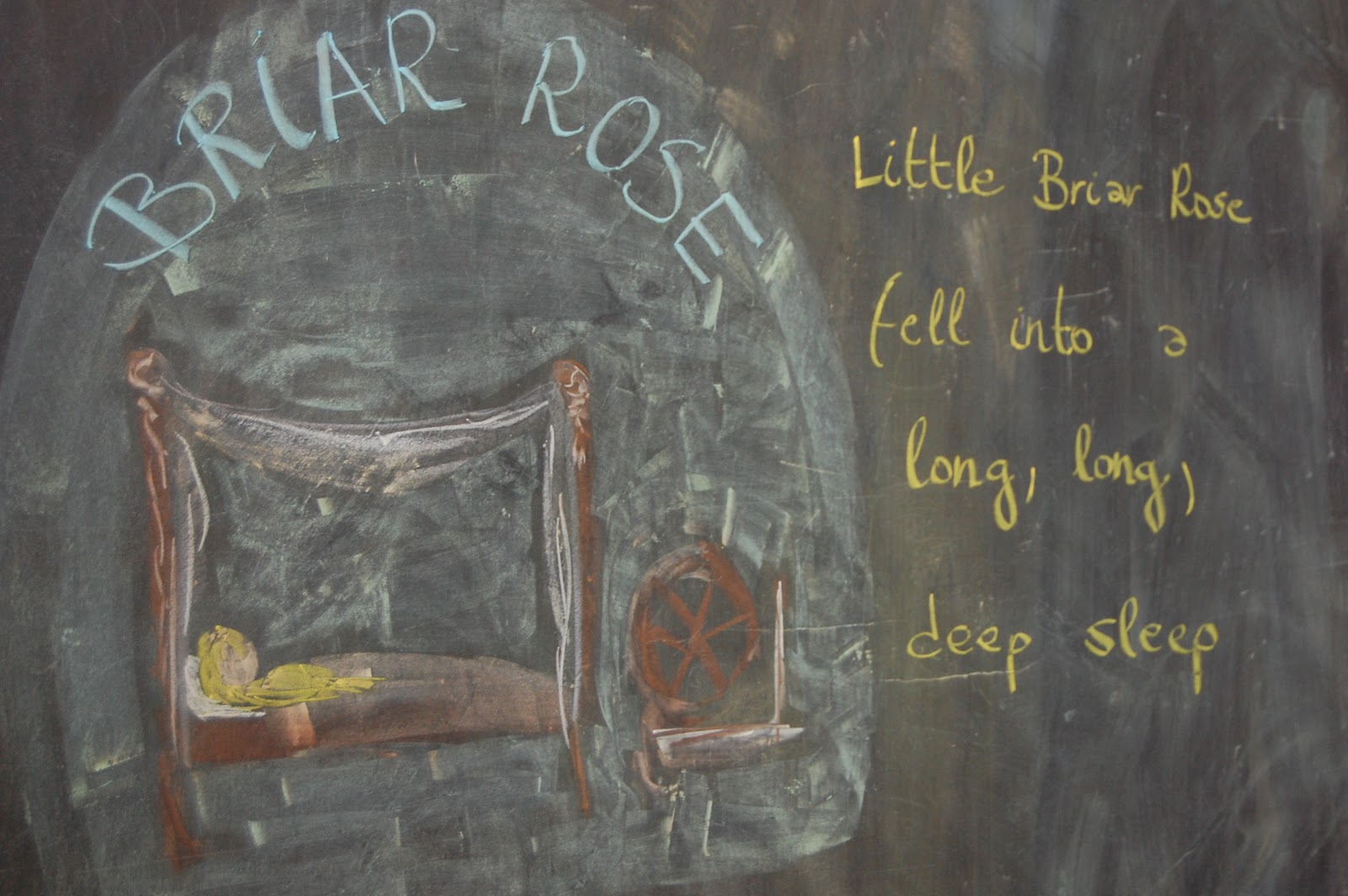
Briar Rose
These weeks we are having stories with a common thread, the sleep and the union of the Prince and Princess, as depicted so clearly in Briar Rose. These are stories of the union of the soul and the spirit which need to take place in order that Man can be awaken. It is also the task of the Consciousness Soul, to take notice of the Spirit so to say:

" So much of the human development hangs on the question of whether human beings can take the next step into the consciousness soul and then onward to the spirit.......One way the opposing forces work on young children is to awaken the nerve-sense system prematurely.........Fairy tales provide wonderful pictures that can live and grow in the children and help them prepare for the time they may become inwardly active and seek the union of the soul and spirit. Rudolf Steiner spoke of fairy tales as being a good angel that accompanies a child from birth onward. He also spoke of the importance of puppetry and marionette work, calling it a remedy for the ills of civilization"

Joan Almond "Early Childhood and the Consciousness Soul"

 
Jacob's Ladder
In falling asleep, or upon awaking, we adults, can also enter into that dreamy state, -"We must look into our soul to see what is there by remaining awake before fully awakening within that dull and dreamy consciousness..." R. Steiner Boundaries of Natural Science -and explore the relationship between the soul and the spirit.

In my experimentation, this in between worlds comes up as dream-like images, where my I has metamorphosed into a character and is living a scenario, I am deemly aware of it, but can notice the images being of a different nature than when fully awake, more rapid, more diverse, more filled. The first thing as consciousness slips away is a slowing of the breathing pattern, I can hear the breath going slower and deeper, and then the sense of hearing notices a feeling of a mantle that comes inwardly from the chest periphery and then upward  away from the crown in the head. Then I am asleep. Before this happens I take time to ask questions, revisit the day and prepare for my journey. Upon awakening I take time to hear what the spiritual world brings, in ideas that arise within myself but that are not my own.

The Seven Ravens
A friend of mine has sent me this poem, and found it to be very relevant to this week, as we seek to work with the angels and the spiritual world:

There is a Knighthood of the 21st Century 
Whose riders do not ride
through the darkness of physical forests, as of old,
but through the forests of darkened minds.
They are armed with a spiritual armor.
And a spiritual sun makes them radiant.
Out of them shines healing,
healing that flows from the knowledge
that the Human Being is a spiritual being.
They must create inner order, inner justice,
Peace and conviction in the darkness of our time.
They must learn to work side by side with Angels.
 
Karl Konig
founder of Camp Hill movement
<http://www.camphill.org>


Wednesday, January 18, 2012

Summary

So this year so far, we have accomplished our goals with the third grader being able to write by herself sentences in a row and make short summaries, playing violin daily and writing dates and weather. We are way behind with math, as we lack the memorization of the multiplication tables, so the multiplication itself and division are lacking.

For the first grader, she is recognizing the letters, yet she is far from linking them to the actual words, and I can see that in general she is half year behind compared to what my first daughter used to know, so, I will just hang in there going along with the curriculum and waiting for the summer to make another assessment.

The kindergarten and nursery children are well learnt in dress up clothes!


I have started this January gradually, the first week we did two days of school, this week we are doing three weeks of school, and next week we will resume our habitual four days of school. I want to establish a faster pace, since I want to count three more months of this type of schooling and then unwire for the planting/spring season, I know that when April comes by, things start to get difficult to contain in the previous forms!


One of my aspirations, besides the festival life that we are sharing with homeschooling families, is to have a Biodynamic farm-school, where we could all go once or twice a week, to do farm work, and where other people in the community would have their work too, I am thinking children with autism, or adults with disabilities, even from the public school or other venues.

As we ponder about this, I am reminded of a sentence of one of my friends regarding the building up of community:

"Community does usually fail when built up for its own sake,
usually is something else that people gather around to,
and as a consequence a true Community arises"

 I am trying to decipher what is that "something else".

Thursday, January 12, 2012

Winter Wool

We are grateful of our wool-shop, they have a good variety of yarns and wool, and also they raise their own sheep. We bought the wool of one of theirs, Widget, and spent some time cleaning and carding it. Now it is time to start spinning, hopefully we will learn with one of those small hand-spinning wheels that they sell also in the shop.

Now that it really snowed finally, and hopefully winter weather is to stay, at least for a while, we are hoping to finish some of our knitting projects, the children knit scarfs (1st Grade) and mittens and bonnets (3rd Grade), and fingerknit (Kindergarten), while I have set to do dresses, vests and pants for them.